ABACUS LCAO Si bands
Unfold an ABACUS LCAO supercell calculation onto the primitive-cell band
path: an 8-atom conventional-cubic Si supercell (plus a Si:P variant)
with the real-space Hamiltonian and overlap exported (out_mat_hs2 1
writes data-HR-sparse_SPIN0.csr / data-SR-sparse_SPIN0.csr),
unfolded onto the 2-atom fcc primitive cell through
HamiltonIO.abacus.abacus_wrapper.AbacusParser, exactly like the
SIESTA example.
Run parameters and shared options (mode, spin, method, resolve_degenerate, supercell-matrix row convention, k-path coordinates and frames, energy-reference conventions) are explained together in the method, parameters, and k-path guide.
Primitive cell input: required for the LCAO abacus route — it supplies the relabel map and the default path cell.
Configuration
# ABACUS LCAO Si: 8-atom conventional-cubic supercell (committed fixture)
# unfolded onto the 2-atom fcc primitive cell along Gamma-X-W-Gamma-L-W-X.
# Companion of reproduce.py; see README.txt.
route = "abacus"

[input]
supercell = "data/si_conv/OUT.si_conv"

[structure]
# 2-atom fcc primitive OUT directory; supercell = M @ primitive
primitive = "data/si_prim/OUT.si_prim"
supercell_matrix = [[-1, 1, 1], [1, -1, 1], [1, 1, -1]]

[path]
special_points = "GXWGLWX"
npts = 300

[options]
mode = "lcao"
method = "ideal"

[output]
output = "abacus_si_unfolded.png"
Running the example
Download the abacus-si bundle, unpack it, and work from the unpacked directory:
tar xzf abacus-si.tar.gz && cd abacus-si
python reproduce.py             # -> abacus_si_unfolded.png + abacus_si_p_doped.png
The bundle ships the committed ABACUS outputs (the sparse H/S tables of
all three runs plus the pseudopotentials and numerical orbitals in
refs/), so no ABACUS installation is needed — only the unfolding
package importable (pip install -e <unfolding repo checkout>) with
numpy, matplotlib and HamiltonIO.
The same computation through the unified CLI:
unfolding --config unfold.toml          # the bundled config
# or, with explicit flags:
unfolding abacus --supercell data/si_conv/OUT.si_conv \
  --primitive data/si_prim/OUT.si_prim \
  --unfold-mat -1 1 1 1 -1 1 1 1 -1 \
  --special-points GXWGLWX --npts 300 \
  --mode lcao --method ideal --output abacus_si_unfolded.png
# the same TOML through the Python entry points
from unfolding import load_config, run
run(load_config("unfold.toml"))and from Python:
import numpy as np
from HamiltonIO.abacus.abacus_wrapper import AbacusParser
from unfolding.lcao_unfolder import HamiltonIOModel, LCAOUnfolder
from unfolding.mapping import RelabelMap

B = np.array([[-1, 1, 1], [1, -1, 1], [1, 1, -1]])   # conv = B @ prim
prim = AbacusParser(outpath='data/si_prim/OUT.si_prim').get_models()
sc = AbacusParser(outpath='data/si_conv/OUT.si_conv').get_models()

rm = RelabelMap.from_atoms(sc.atoms, prim.atoms, B,
                           orb_counts_sc=[13]*8, orb_counts_prim=[13, 13])
unf = LCAOUnfolder(HamiltonIOModel(sc), rm)
res = unf.compute(kpts, method="ideal")
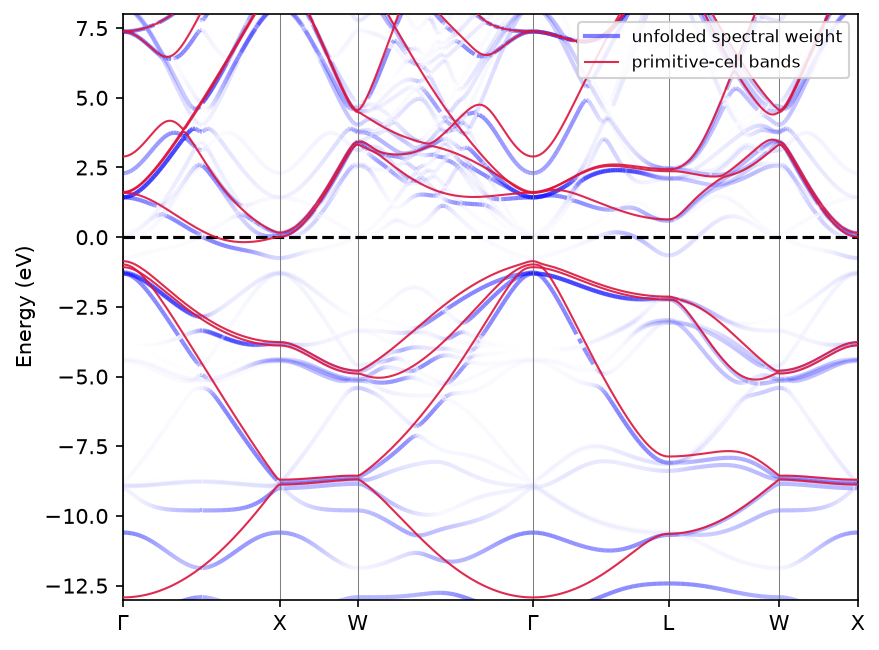
For the doped supercell, replace one Si by P in the STRU and pass
match_species=False so the dopant folds onto the host site it
replaces (the shipped si7p run already has this substitution).
Structures
- Primitive cell: 2-atom fcc, a = 5.43 Å (
LATTICE_CONSTANT 10.2632bohr for the ABACUS runs) —cell = [[0, a/2, a/2], [a/2, 0, a/2], [a/2, a/2, 0]]. - Supercell: 8-atom conventional cubic cell with
M = [[-1, 1, 1], [1, -1, 1], [1, 1, -1]]; the Si7P fixture substitutes P on the (¼,¼,¼) site. - Basis: DZP numerical orbitals
Si_gga_10au_100Ry_2s2p1d(13 orbitals per Si atom); the Si:P run addsP_gga_10au_100Ry_2s2p1dfor the dopant (also 13 orbitals). ABACUS ≤ 3.10 does not writeOUT.${suffix}/Orbital, so the basis is reconstructed from the STRU — the orbital files ship inrefs/. - Run settings:
basis_type lcao,esolver_type ksdft, PBE,ecutwfc 100Ry,symmetry 0, Γ-centered 2×2×2 k-grid,out_mat_hs2 1, Gaussian smearing σ = 0.005 Ha.
K-path
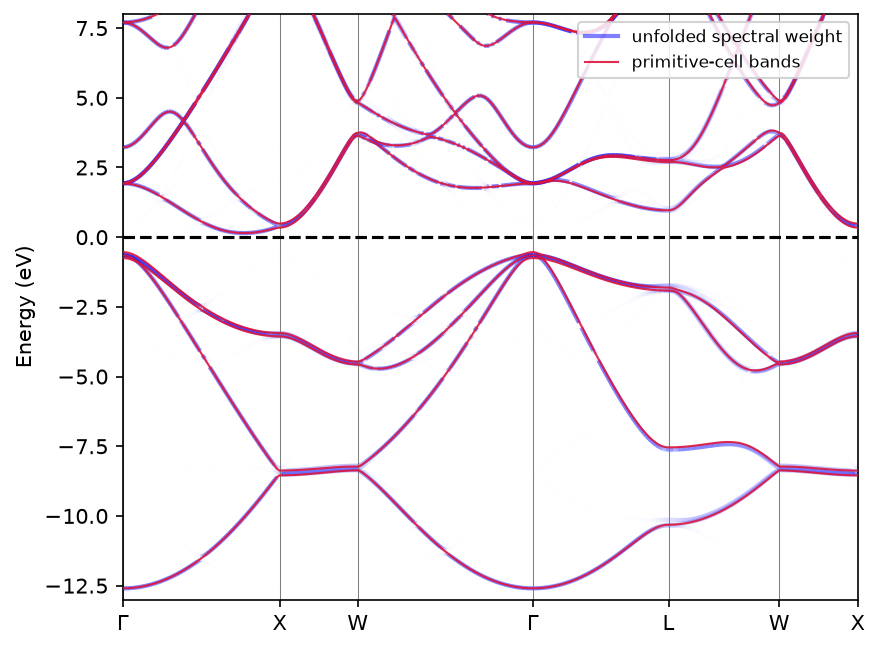
Γ–X–W–Γ–L–W–X, 300 points; the plot window is −13…8 eV.
Parameters
| Parameter | Meaning |
|---|---|
supercell / primitive | the OUT.* directories of the supercell and primitive-cell runs (sparse tables + logs) |
match_species | false maps the P dopant onto the host Si site it replaces |
orb_counts | orbitals per atom (13 for DZP 2s2p1d) used by the atom map |
Calculation background
The parsed model exposes the full unfolding interface: atoms (ASE
Atoms of the supercell), HR/SR dicts keyed by integer lattice
translations (HR in eV), and hs_and_eigen(k). Every weight-1
unfolded branch lies on the independently computed primitive-cell bands
(the crimson overlay), which validates the parser’s orbital ordering
and phase conventions. To re-run ABACUS yourself, point
pseudo_dir/orbital_dir at refs/ (the shipped INPUT files use
../refs) and run abacus in each data/<name> directory; a
k-sampled SCF is essential — a Γ-only run collapses all image shells
into the R = 0 block, which cannot be unfolded at generic momenta.