ABINIT PAW plane-wave unfolding: Si and Si:P
Unfold ABINIT PAW plane-wave calculations with the
unfold_abinit_paw adapter: 8-atom pristine Si and 8-atom Si:P
supercells onto the 2-atom primitive fcc cell, with a separately
computed 2-atom primitive WFK supplying the reference bands. The PAW
wavefunction is normalized in the overlap metric, so overlaps are
evaluated with S = I + Σ_aij |p_ai⟩ ΔS_aij ⟨p_aj| (only the overlap
augmentation ΔS enters the projection).
Run parameters and shared options (mode, spin, method, resolve_degenerate, supercell-matrix row convention, k-path coordinates and frames, energy-reference conventions) are explained together in the method, parameters, and k-path guide.
Primitive cell input: required for the abinit-paw route — it provides the primitive-cell wavefunctions the supercell is projected onto.
Configuration
# ABINIT PAW Si:P: the shipped Gamma-point WFKs unfolded onto the four
# primitive folds of supercell Gamma (companion of reproduce.py; see
# README.txt). Weights live at the primitive WFK's stored k-points.
route = "abinit-paw"

[input]
supercell = "data/si7p_gammao_WFK.nc"
primitive = "data/si_primitive_foldso_WFK.nc"
# directory holding the JTH datasets <Symbol>.xml (Si.xml, P.xml)
paw = "data"

[structure]
# supercell = M @ primitive (conventional cubic cell in primitive units)
supercell_matrix = [[-1, 1, 1], [1, -1, 1], [1, 1, -1]]

[path]
# tick labels for the four stored folds (xticks required with names)
names = ["Γ", "(0,½,½)", "(½,0,½)", "(½,½,0)"]
xticks = [0.0, 1.0, 2.0, 3.0]

[options]
spin = 0
resolve_degenerate = 0.001

[output]
output = "abinit_paw_si7p_gamma.png"
Running the example
Download the abinit-paw bundle, unpack it, and work from the unpacked directory:
tar xzf abinit-paw.tar.gz && cd abinit-paw
python reproduce.py             # -> abinit_paw_si7p_gamma.png
The bundle ships the committed Γ-point WFKs (Si8, Si7P and the 2-atom
primitive reference) and the JTH PAW XML datasets, so the Γ-fold figure
needs no ABINIT run — only the unfolding package importable (pip install -e <unfolding repo checkout>) with numpy, matplotlib, netCDF4
and pypao. The dense Γ-X-W-Γ-L-W-X path figure additionally needs the
path WFKs (~250 MB each, not shippable): regenerate them from the
bundled decks with your own ABINIT >= 10 (bash regenerate_path.sh
next to the XMLs) and follow the path recipe below.
The same Γ computation through the unified CLI:
unfolding --config unfold.toml          # the bundled config
# or, with explicit flags:
unfolding abinit-paw --supercell data/si7p_gammao_WFK.nc \
  --primitive data/si_primitive_foldso_WFK.nc --paw data \
  --unfold-mat -1 1 1 1 -1 1 1 1 -1 \
  --names 'Γ' '(0,½,½)' '(½,0,½)' '(½,½,0)' --xticks 0 1 2 3 \
  --resolve-degenerate 0.001 --output abinit_paw_si7p_gamma.png
# the same TOML through the Python entry points
from unfolding import load_config, run
run(load_config("unfold.toml"))and from Python:
from pathlib import Path
from HamiltonIO.abinit import HARTREE_TO_EV
from unfolding.abinit_paw import unfold_abinit_paw

data = Path('data')
xml = {symbol: data / f'{symbol}.xml' for symbol in ('Si', 'P')}
M = [[-1, 1, 1], [1, -1, 1], [1, 1, -1]]
result = unfold_abinit_paw(data/'si7p_gammao_WFK.nc',
                           data/'si_primitive_foldso_WFK.nc', xml, M,
                           resolve_degenerate=1e-3 / HARTREE_TO_EV)
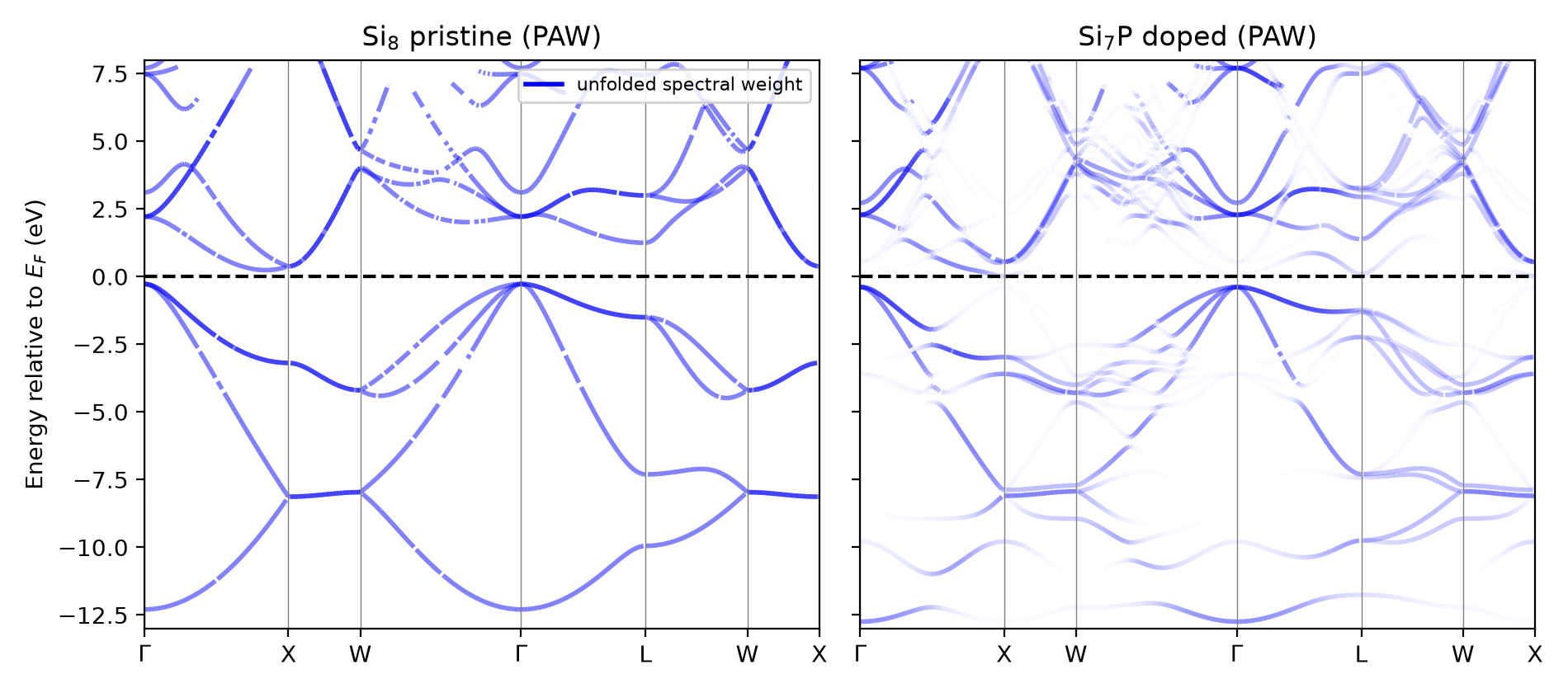
For the dense-path figure, place the regenerated
si8_paw_patho_DS2_WFK.nc, si7p_paw_patho_DS2_WFK.nc and
si_prim_paw_patho_DS2_WFK.nc in data/, then unfold each supercell
WFK against the primitive one exactly as in reproduce.py (the decks
already sample the 305-point path in supercell coordinates); the top
of the 32-band manifold above ~6 eV sits in the
unconverged Davidson tail (trust energies below that).
HamiltonIO.abinit.read_paw_wfk reads ABINIT 9/10 netCDF WFKs and JTH
PAW XML datasets (via pypao); the ordinary
norm-conserving route (unfold_abinit)
rejects PAW WFKs rather than treating them as norm-conserving.
Structures
- Primitive cell: 2-atom fcc,
acell 3*10.26bohr,rprim 1 0 0 0 1 0 0 0 1, Si at xred (0,0,0) and (¼,¼,¼). - Supercell: 8-atom conventional cubic cell with
M = [[-1, 1, 1], [1, -1, 1], [1, 1, -1]]; the Si7P fixture replaces the (¼,¼,¼) atom by P (znucl 15). - Atomic data: JTH PAW datasets (Psdj_paw_pbe_std)
Si.xml/P.xml— they ship with the bundle and are consumed through pypao. - Run settings:
ixc 11,ecut 10Ha,pawecutdg 20Ha,nband 32,occopt 3,tsmear 0.005,iomode 3(netCDF WFK),istwfk 1at Γ,chkprim 0(the supercell is not primitive).
K-path
Γ-fold figure: the four primitive momenta folding to supercell Γ — Γ, (0,½,½), (½,0,½), (½,½,0); the weights live at the primitive WFK’s stored k-points.
Dense-path figure: Γ–X–W–Γ–L–W–X, 305 points; the supercell decks
sample the same path in supercell coordinates as an explicit kpt
list (kptopt 0, ndtset 2:
dataset 1 SCF at supercell Γ writing the density, dataset 2
frozen-density non-SCF with iscf -2, getden 1, tolwfr 1e-16);
window −13…8 eV.
Parameters
| Parameter | Meaning |
|---|---|
supercell / primitive | netCDF WFK paths (or parsed AbinitPawData); the primitive reference may be pristine Si while the supercell carries the dopant |
datasets / paw | maps chemical symbols to the matching JTH XML paths |
pseudo_weights | result attribute: the pseudo-coset fractions, resolved with the same degenerate blocks |
Calculation background
All decks ship in inputs/: the three Γ decks that produced the
committed WFKs and the three dense-path decks for the regeneration.
Both WFK banks need compatible spin channels and commensurate cells;
the projector-block cache is bounded, so a 305-point run costs no more
memory than a 4-point one. In the doped system the impurity couples
sectors at band crossings, so isolated weights go fractional there
while whole valence regions stay binary; pristine sectors never mix
(max non-degenerate |w(1−w)| ~1e-6 below the Davidson tail).