OpenMX Si bands
Unfold an OpenMX supercell calculation
onto the primitive-cell band path: an 8-atom conventional-cubic Si
supercell (plus a Si:P variant) unfolded onto the 2-atom fcc primitive
cell from the binary .scfout file (real-space Hamiltonian and overlap,
written with HS.fileout on), parsed by the HamiltonIO OpenMX adapter
(pure python, no OpenMX runtime needed).
Run parameters and shared options (mode, spin, method, resolve_degenerate, supercell-matrix row convention, k-path coordinates and frames, energy-reference conventions) are explained together in the method, parameters, and k-path guide.
Primitive cell input: required for the openmx route — it supplies the relabel map and the default path cell.
Configuration
# OpenMX Si: 8-atom conventional-cubic supercell (committed fixture)
# unfolded onto the 2-atom fcc primitive cell along Gamma-X-W-Gamma-L-W-X.
# Companion of reproduce.py; see README.txt.
route = "openmx"

[input]
scfout = "data/openmx_si_sc.scfout"

[structure]
# 2-atom fcc primitive cell (ASE-readable); supercell = M @ primitive
primitive = "data/si_prim.vasp"
supercell_matrix = [[-1, 1, 1], [1, -1, 1], [1, 1, -1]]

[path]
# fcc special points on the primitive cell, 300 points
special_points = "GXWGLWX"
npts = 300

[options]
method = "ideal"
# efermi omitted: 0.0 means use the ChemP stored in the scfout

[output]
output = "openmx_si_unfolded.png"
Running the example
Download the openmx-si bundle, unpack it, and work from the unpacked directory:
tar xzf openmx-si.tar.gz && cd openmx-si
python reproduce.py                     # -> openmx_si_unfolded.png
The bundle ships the committed OpenMX outputs (data/openmx_si_sc.scfout
for the 8-atom supercell and the 2-atom primitive reference) plus the
.dat inputs, so the pristine figure needs no OpenMX installation —
only the unfolding package importable (pip install -e <unfolding repo checkout>) with numpy, matplotlib, ase and HamiltonIO.
The same computation through the unified CLI:
unfolding --config unfold.toml          # the bundled config
# or, with explicit flags:
unfolding openmx --scfout data/openmx_si_sc.scfout \
  --primitive data/si_prim.vasp \
  --unfold-mat -1 1 1 1 -1 1 1 1 -1 \
  --special-points GXWGLWX --npts 300 --method ideal \
  --output openmx_si_unfolded.png
# the same TOML through the Python entry points
from unfolding import load_config, run
run(load_config("unfold.toml"))and the same computation from Python, either through the config file
(unfolding.config.load_config validates, unfolding.run executes) or
with explicit adapter parameters:
import numpy as np
from ase import Atoms
from unfolding import unfold_openmx

a = 5.43
prim = Atoms('Si2',
             scaled_positions=[(0, 0, 0), (0.25, 0.25, 0.25)],
             cell=[[0, a/2, a/2], [a/2, 0, a/2], [a/2, a/2, 0]],
             pbc=True)

ax = unfold_openmx(
    scfout='data/openmx_si_sc.scfout',         # 8-atom conventional cell
    prim_atoms=prim,                           # 2-atom fcc primitive cell
    unfold_sc_mat=np.array([[-1, 1, 1],        # conv cell = M @ prim
                            [1, -1, 1],
                            [1, 1, -1]]),
    kpts=kpts, knames=knames, xqpts=x, Xqpts=X,
    method='ideal',
)
The doped figure (openmx_si_p_doped.png) needs the Si7P scfout, which
is not shipped (three scfouts exceed the 10 MB bundle cap): produce it
with OpenMX from the bundled inputs/openmx_si_sc_p.dat — copy your
Si_PBE19.vps / P_PBE19.vps pseudopotentials next to it, run
openmx openmx_si_sc_p.dat, place the resulting scfout in data/, then
python reproduce.py --doped.
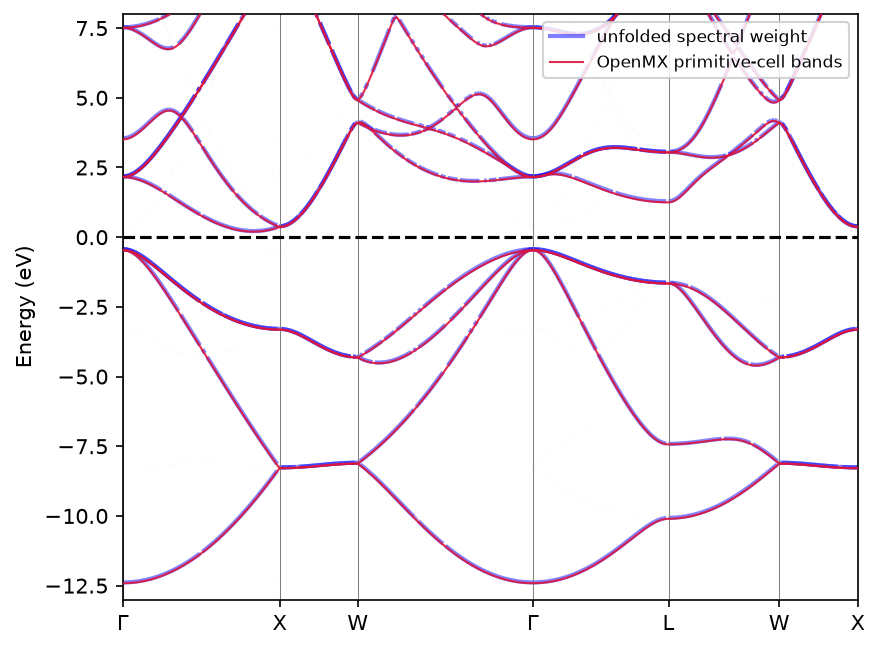
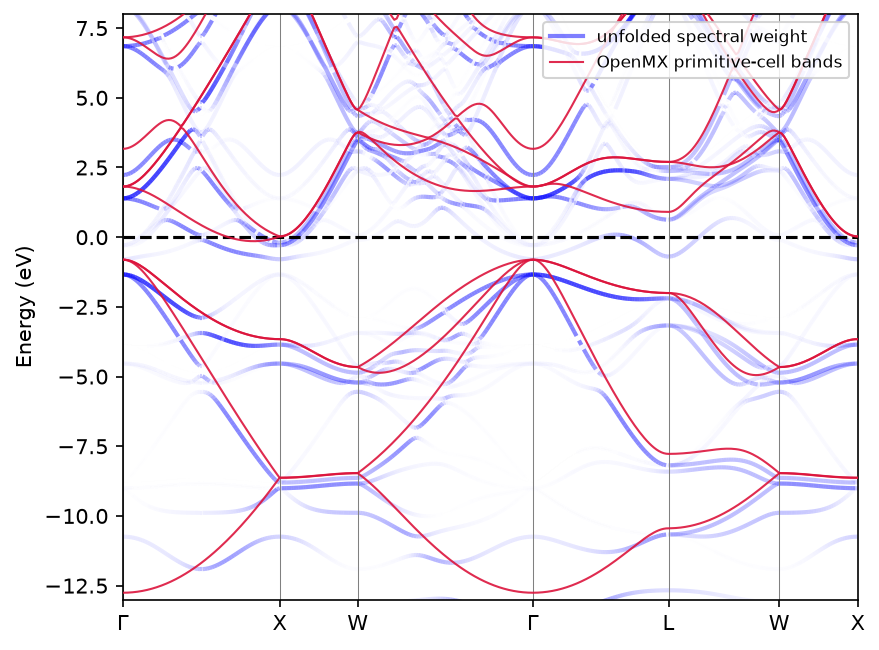
Structures
- Primitive cell: 2-atom fcc, a = 5.43 Å —
cell = [[0, a/2, a/2], [a/2, 0, a/2], [a/2, a/2, 0]], Si at (0,0,0) and (1/4,1/4,1/4) fractional. Shipped asdata/si_prim.vasp(any ASE-readable format works). - Supercell: 8-atom conventional cubic cell, related by the
supercell matrix
M = [[-1, 1, 1], [1, -1, 1], [1, 1, -1]]. - Basis: Si7.0-s2p2d1 (13 orbitals per Si atom), Si_PBE19 pseudopotentials (OpenMX 2019 data set), GGA-PBE, spin unpolarized.
- For Si:P, substitute one Si by P (same 13-orbital
P7.0-s2p2d1basis) and map the dopant onto the host site it replaces (match_species=false, as in the SIESTA Si:P example).
K-path
Γ–X–W–Γ–L–W–X, 300 points; the plot window is −13…8 eV.
Parameters
| Parameter | Meaning |
|---|---|
scfout | binary OpenMX output (needs HS.fileout on); parsed by HamiltonIO |
primitive | primitive-cell structure (ASE-readable) the branches are labeled with |
match_species | map supercell atoms onto same-species primitive sites (false for substitutional dopants) |
tol_r | atom-matching tolerance in Å (default 0.04) |
efermi | Fermi level in eV; the default 0.0 means “use ChemP from the scfout” |
Calculation background
The committed fixtures are the exact runs behind the figures, produced
with OpenMX 3.9 (2019 data files), GGA-PBE, scf.EigenvalueSolver band, HS.fileout on: a 2-atom primitive cell on a 4×4×4 k-grid and
8-atom conventional cells on 2×2×2 k-grids. A k-sampled SCF is
essential: a Γ-only run collapses all supercell image shells into a
single R = 0 block, which cannot be unfolded at generic momenta.
Conventions: OpenMX builds H(k) = Σ_R exp(+2πi k·R) H(R) with
fractional k-points and the integer image translations R from
atv_ijk; scfout energies are Hartree and the geometry Bohr, both
converted on parse. The supercell inputs ship in inputs/ so every run
can be regenerated from scratch.