TB2J magnons SrMnO3
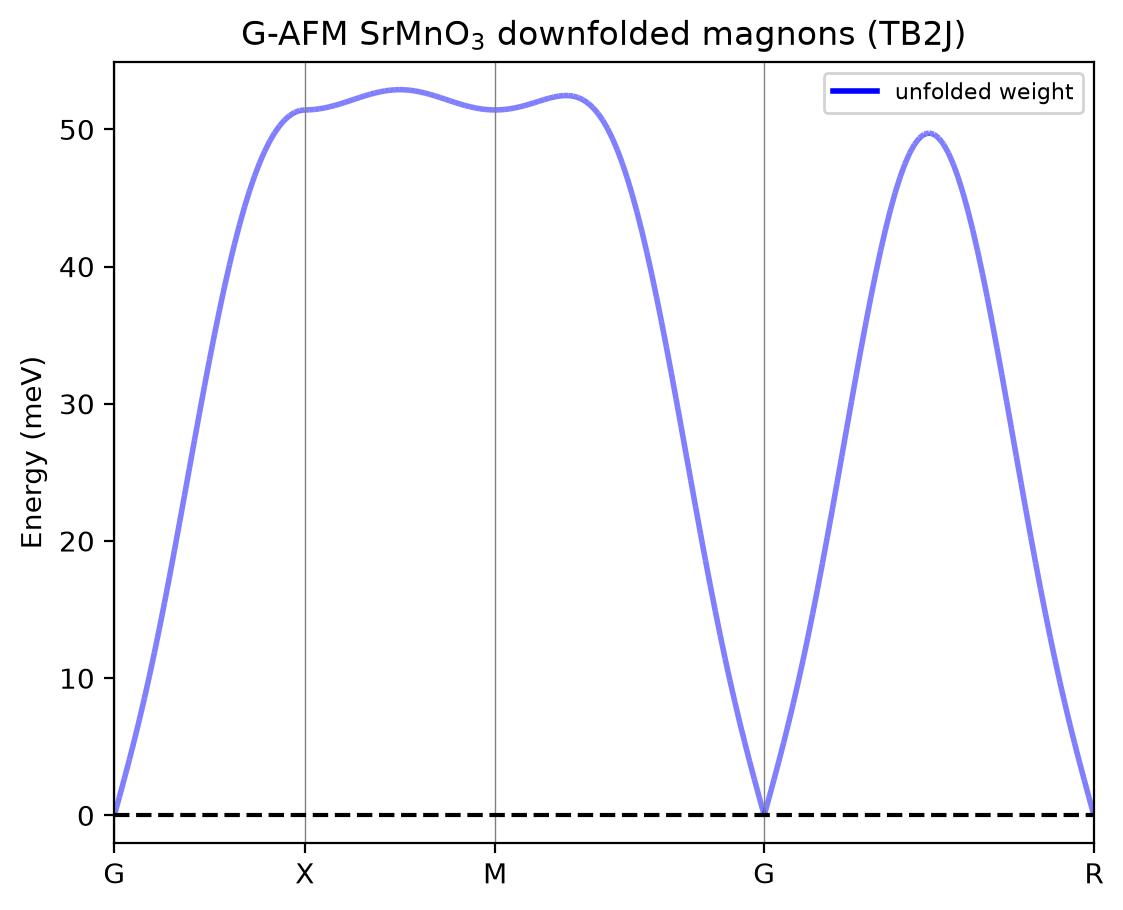
Downfold magnon band structures computed from TB2J exchange parameters onto the primitive magnon Brillouin zone: the antiferromagnetic DFT cell (√2×√2×√2 G-AFM SrMnO₃, 10 atoms) is larger than the chemical primitive cell (5-atom pseudo-cubic, one Mn), so the magnon bands fold and unfolding assigns each folded branch its primitive-cell momentum.
SrMnO3 VASP/Wannier90 DFT (G-AFM)
  -> TB2J pickle: JR tensors, 10-atom sqrt2 x sqrt2 x sqrt2 cell, 2 Mn
  -> TB2J Magnon: BdG magnon bands (collinear reference, Q = 0)
  -> unfolding: weights on the 5-atom pseudo-cubic primitive cell
The bundle
Download tb2j-magnon-srmmo3.tar.gz and unpack it:
tar xf tb2j-magnon-srmmo3.tar.gz && cd tb2j-magnon-srmmo3
Shipped: the TB2J exchange parameters (data/TB2J_results/TB2J.pickle,
from a VASP/Wannier90 G-AFM run: 10 atoms, 2 Mn at ±2.81 μB, propagation
Q=(½,½,½)), unfold.toml, and reproduce.py. Prerequisites:
pip install "unfolding[tb2j]" (TB2J).
Structure and k-path
| unfold matrix | M = [[0,1,1],[1,0,1],[1,1,0]], the 10-atom AFM cell in 5-atom pseudo-cubic units |
| primitive cell | derived as inv(M) @ TB2J cell; the q-path special points are resolved on it |
| q-path | Γ-X-M-Γ-R, 200 points |
| reference | collinear two-sublattice frame: Q = 0, quantization axis ẑ, moments from the pickle (spiral references are not supported in v1) |
Run parameters and shared options (mode, spin, method, resolve_degenerate, supercell-matrix row convention, k-path coordinates and frames, energy-reference conventions) are explained together in the method, parameters, and k-path guide.
Primitive cell input: not used by the magnon route — the path cell is derived from the TB2J cell and the unfolding matrix.
Configuration
# TB2J magnons: G-AFM SrMnO3, 10-atom AFM cell -> 5-atom pseudo-cubic cell.
# Run from the unpacked bundle root:  unfolding --config unfold.toml
# or with explicit flags:
#   unfolding magnon --results data/TB2J_results \
#     --unfold-mat 0 1 1 1 0 1 1 1 0 --special-points GXMGR \
#     --npts 200 --output magnon_unfolded_cli.png
route = "magnon"

[input]
results = "data/TB2J_results"          # directory holding TB2J.pickle

[structure]
supercell_matrix = [[0, 1, 1], [1, 0, 1], [1, 1, 0]]   # A_afm = M @ A_pc

[path]
special_points = "GXMGR"               # resolved on inv(M) @ TB2J cell (pseudo-cubic)
npts = 200

[output]
output = "magnon_unfolded_cli.png"
Run it
From the unpacked bundle directory, one command with the shipped config:
unfolding --config unfold.toml # -> magnon_unfolded_cli.png
The same TOML can be passed as the only Python input:
from unfolding import load_config, run
run(load_config("unfold.toml"))
or with explicit flags:
unfolding magnon --results data/TB2J_results \
    --unfold-mat 0 1 1 1 0 1 1 1 0 --special-points GXMGR \
    --npts 200 --output magnon_unfolded_cli.png
or through the Python API with explicit parameters:
import numpy as np
from unfolding import unfold_tb2j

m_afm = np.array([[0, 1, 1], [1, 0, 1], [1, 1, 0]])   # A_afm = M @ A_pc

ax = unfold_tb2j(
    "data/TB2J_results",              # directory with TB2J.pickle
    m_afm,
    qpts,                             # pseudo-cubic primitive q-path
    knames=[r"$\Gamma$", "X", "M", r"$\Gamma$", "R"],
    xqpts=x, Xqpts=X,
)
reproduce.py renders the published figure through the Python API
and checks the physics seals — a Goldstone mode at Γ
(< 0.05 meV) and binary unfolding weights (every weight 0 or 1 to
1e-8) for the pristine G-AFM:
python reproduce.py # -> srmmo3_unfolded_api.png, srmmo3.png
For your own system: run TB2J on the AFM supercell (any supported DFT
code), keep the TB2J_results directory, and set the unfold matrix
that relates your AFM cell to the primitive cell.